When choosing a retail kiosk, most store owners start with one question:
“How big can I make it?”
A better question is:
“How big should it be?”
A kiosk that looks impressive on a showroom floor can become a problem once it is inside your store. It can block customer traffic, reduce product visibility, or leave your employees with barely enough room to work.
Whether you are opening a candy shop, jewelry store, bubble tea shop, perfume store, or mall retail space, the right kiosk size should be based on how the business actually operates.
Here is what to consider before ordering one.
1. Measure the Space You Can Actually Use
Start with the floor, not the kiosk.
Measure the available length and width, but also mark doors, columns, walls, entrances, fire exits, electrical outlets, and existing fixtures.
Then look at the remaining open area.
A 6-foot kiosk might technically fit into a space, but if customers have to squeeze around it, it is probably too large.
Leave enough room for people to walk comfortably, stop to browse, and move past other customers.
A kiosk should organize traffic—not create a traffic jam.
2. Think About What the Kiosk Needs to Hold
A kiosk selling sunglasses has completely different space requirements from a bubble tea counter.
For example:
Candy shop:
Open bins, shelves, impulse displays, and hidden stock storage.
Jewelry store:
Glass display areas, drawers, lockable storage, lighting, and a secure checkout area.
Bubble tea shop:
POS equipment, cups, sealing machines, ingredients, refrigerators, and working space.
Perfume store:
Product shelves, testers, lighting, storage, and enough countertop space for customers to try products.
Before deciding the dimensions, make a simple list of everything that needs to fit inside.
You may discover that you need less floor space but more vertical storage.
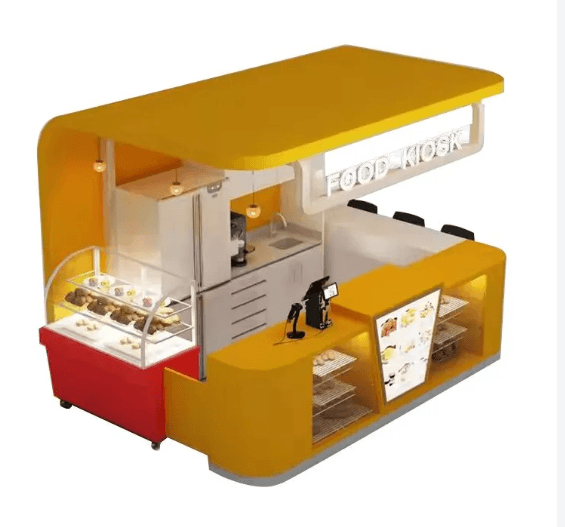
3. Don't Waste Floor Space on Empty Countertop
More countertop does not automatically mean a better kiosk.
If the counter is 8 feet long but half of it is unused, you have paid for furniture that is taking up valuable retail space.
Instead, divide the kiosk into zones:
Checkout/POS
Product presentation
Employee workspace
Storage
Every section should have a job.
This is especially important for small stores where every square foot has to earn its place.
4. Height Can Give You More Display Space
When floor space is limited, look upward.
A taller kiosk can provide additional shelves, signage, lighting, and product displays without increasing the footprint.
But there is a limit.
Products placed too high become difficult for customers to see and employees to reach.
Keep your most important products within comfortable viewing and reaching height. Use the upper section for branding, larger visual displays, or products that do not need frequent handling.
5. Consider How Many People Will Work There
A kiosk designed for one employee is very different from one designed for two or three.
If employees need to stand behind the kiosk, measure the working area—not just the customer-facing dimensions.
Think about:
Can an employee open the cabinet door without hitting another person?
Can they reach the POS system without walking around the counter?
Can two employees pass each other?
These details may sound minor during the design stage. They become very noticeable after eight hours of daily operation.
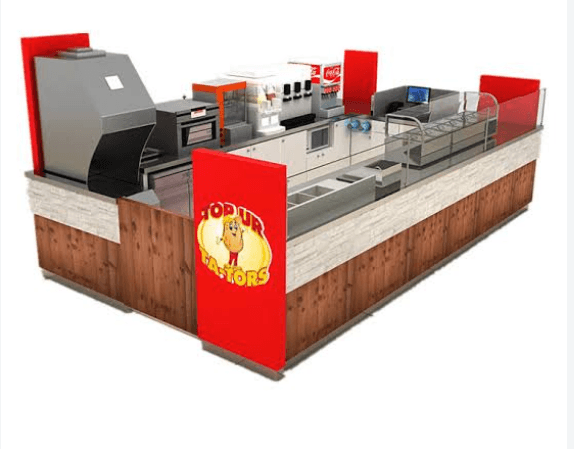
6. Small Kiosks Can Be Better for High-Traffic Locations
A common mistake is assuming a larger kiosk attracts more customers.
In a busy mall or shopping center, a compact kiosk can actually work better.
A smaller footprint gives customers more room to approach the products from different directions. It can also make the merchandise easier to see from a distance.
For impulse purchases—candy, accessories, cosmetics, toys, or small gifts—you may not need a huge structure.
Visibility and accessibility can be more valuable than size.
7. Don't Forget Storage
This is one of the biggest differences between a pretty kiosk and a useful kiosk.
Retail stores constantly need somewhere to put:
Extra inventory
Shopping bags
Packaging
Cleaning supplies
POS materials
Promotional items
Employee supplies
If all of your storage is visible, the kiosk can quickly look messy.
Consider adding drawers, closed cabinets, adjustable shelves, or a concealed lower section.
For a small store, hidden storage can be worth more than another display shelf.
8. Plan Around Your Best-Selling Products
Not every product deserves the same amount of space.
If 20% of your products generate most of your sales, give those products the strongest positions.
For example, a candy kiosk could put best-selling packaged candy at eye level while keeping bulk stock underneath.
A jewelry kiosk might place premium pieces in locked glass displays while using smaller sections for accessories.
The kiosk should support your sales strategy—not simply fill an empty corner.
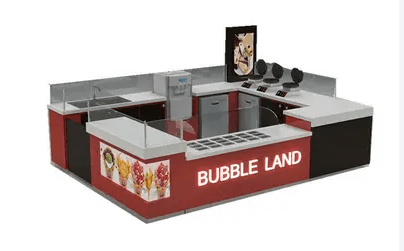
9. Think About Delivery Before You Finalize the Design
A large custom kiosk may need to be divided into several sections for transportation and installation.
Before approving the final design, check:
Shipping dimensions
Doorway size
Elevator size
Stair access
Assembly requirements
Installation location
This is particularly important when ordering custom furniture from overseas.
The finished kiosk may fit perfectly inside the store, but individual components still need to get through the building.
10. Start With Your Business, Then Choose the Size
There is no universal “best” kiosk size.
A 4-foot kiosk might be perfect for one business and completely inadequate for another.
Before asking a manufacturer for a quotation, prepare five things:
1. Available floor space
2. Products you plan to display
3. Equipment that must be installed
4. Number of employees using the kiosk
5. Storage you need
Then send a few photos or a rough floor plan.
A manufacturer can use that information to recommend a practical footprint instead of simply making the biggest kiosk that fits.
The Best Kiosk Is Not the Biggest One
A successful retail kiosk should do three things well:
Attract attention.
Make products easy to shop.
Make daily work easier for your staff.
If it does those three things without wasting valuable floor space, you probably have the right size.
And that is a much better starting point than simply asking, “How big can we make it?”